
R for Clinical Programming
We build validated R environments for end-to-end clinical programming, including SDTM, ADaM, TLFs, and reusable functions derived from existing SAS macro logic.

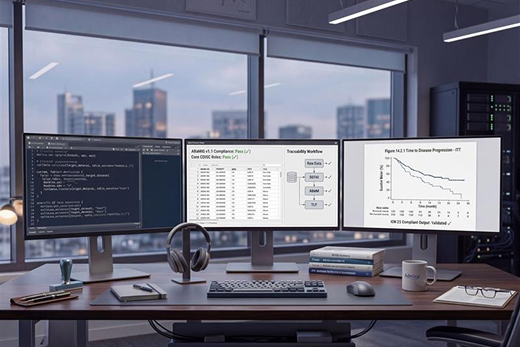
Building Production-Ready R for Clinical Programming and custom Solutions
At IQA, R for Clinical Programming is not limited to SAS migration. We help sponsors build validated R environments for real clinical delivery, including SDTM, ADaM, TLFs, reproducible reporting, and submission-ready outputs. Our approach combines programming expertise, standards alignment, and engineering discipline so R operates as a controlled, production-grade environment.
We support both greenfield R development and coexistence models where R is introduced alongside existing SAS workflows. This includes reusable R functions built from new designs or existing SAS macro logic, metadata-driven programming, automated QC, traceable outputs, and deployment models aligned with CDISC expectations, regulatory review, and GxP-ready operations. We also develop custom R and R Shiny solutions for RBQM, data validation, review dashboards, analytics, and clinical decision support.
What We Build in R
End-to-End R Capabilities for Clinical Programming and Clinical Data Solutions
From validated R environments and SAS coexistence to R-first study builds, interactive dashboards, and submission-ready outputs.
SAS-to-R Migration & Function Modernization
Hybrid Parallel Execution
R-First Study Starts
Metadata-Driven Toolkits & Automation
R Shiny & Interactive Clinical Applications
Managed GxP Infrastructure & Deployment
A validation-first framework for greenfield R builds, SAS-R parallel execution and controlled clinical delivery
Assess
Review scope, existing assets, metadata, outputs, standards, environment needs, and where R can create the most value.
Design
Define the delivery model, whether R-first, SAS-R parallel, or selective coexistence, along with standards, validation, and governance.
Build
Develop reusable R functions, packages, metadata-driven workflows, and study-specific programming components.
Validate
Perform output comparison, QC review, standards check, traceable validation, discrepancy resolution, and confirm output consistency.
Stabilize
Finalize environments, SOPs, documentation, controlled access, and production readiness.
Operate
Run in production through greenfield delivery, parallel execution, or phased rollout with ongoing support and enhancement.
Assess
Review scope, existing assets, metadata, outputs, standards, environment needs, and where R can create the most value.
Design
Define the delivery model, whether R-first, SAS-R parallel, or selective coexistence, along with standards, validation, and governance.
Build
Develop reusable R functions, packages, metadata-driven workflows, and study-specific programming components.
Validate
Perform output comparison, QC review, standards check, traceable validation, discrepancy resolution, and confirm output consistency.
Stabilize
Finalize environments, SOPs, documentation, controlled access, and production readiness.
Operate
Run in production through greenfield delivery, parallel execution, or phased rollout with ongoing support and enhancement.
Dynamic R Programming, Built on IQA Solutions
Our R programming model combines trusted open-source frameworks with IQA-built solutions like Clinevra and eTLF to dynamically generate specifications, programming components, and submission-ready outputs.
R for Clinical Programming, Built for Real Delivery
Validated environments, dynamic automation, and sponsor-ready clinical workflows designed for traceable, submission-ready R delivery.
Clinical Programming, Not Just Migration
We help sponsors build real R-based clinical programming capability for SDTM, ADaM, TLFs, reproducible reporting, and submission-ready outputs.
Validated R Environments
Our delivery model is built on controlled R environments using Posit / R Workbench, version locking, governed access, and GxP-aware operating practices.
Dynamic Programming with IQA Solutions
Clinevra and eTLF help generate R-ready specifications, reusable programming components, and configurable outputs for faster, more consistent delivery.
SAS Coexistence or R-First Delivery
We support greenfield R builds, SAS–R parallel execution, and selective coexistence models based on sponsor needs, timelines, and risk tolerance.
Automation with Traceability
Metadata-driven workflows, reusable packages, automated QC, and R Shiny traceability apps improve speed without compromising control.
Built for Review and Scale
Our R frameworks support reproducible programming, audit-ready outputs, and scalable delivery across studies, teams, and standards.
What Differentiates IQA
Proven Impact in Clinical Programming
Real-world results from global pharma and biotech partnerships - validated, measurable and audit-ready.
The Seamless Migration: 100+ Libraries Converted
A Global Pharma sponsor needed to transition 100+ legacy SAS macro libraries to R to reduce licensing overhead without compromising 10 years of validated clinical history.
IQA's migration team utilized our proprietary IQA-Suite to automate the macro-to-function conversion, followed by side-by-side validation against historical TLF outputs.
Per-study programming spend eliminated through SAS license retirement and R automation.
Zero discrepancies in CDISC-compliant outputs across all 100+ converted macro libraries.
Transition completed 2 weeks ahead of the mid-year submission deadline.
The Interactive Submission: Real-Time Safety Portal
A mid-size biotech running a pivotal oncology trial needed real-time safety signal monitoring across 40+ global sites - but their static PDF reporting cycle left a dangerous two-week blind spot between data cuts.
IQA built a validated R Shiny Safety Portal with live Kaplan-Meier survival curves, interactive adverse event filtering by SOC/PT and severity and automated SUSAR flagging - all connected to the sponsor's live EDC feed with 21 CFR Part 11-compliant audit trails.
Ready to scale your R-Clinical production?
Start with a no-commitment readiness audit - we map your SAS estate, quantify migration complexity and deliver a phased roadmap with zero disruption to active timelines.